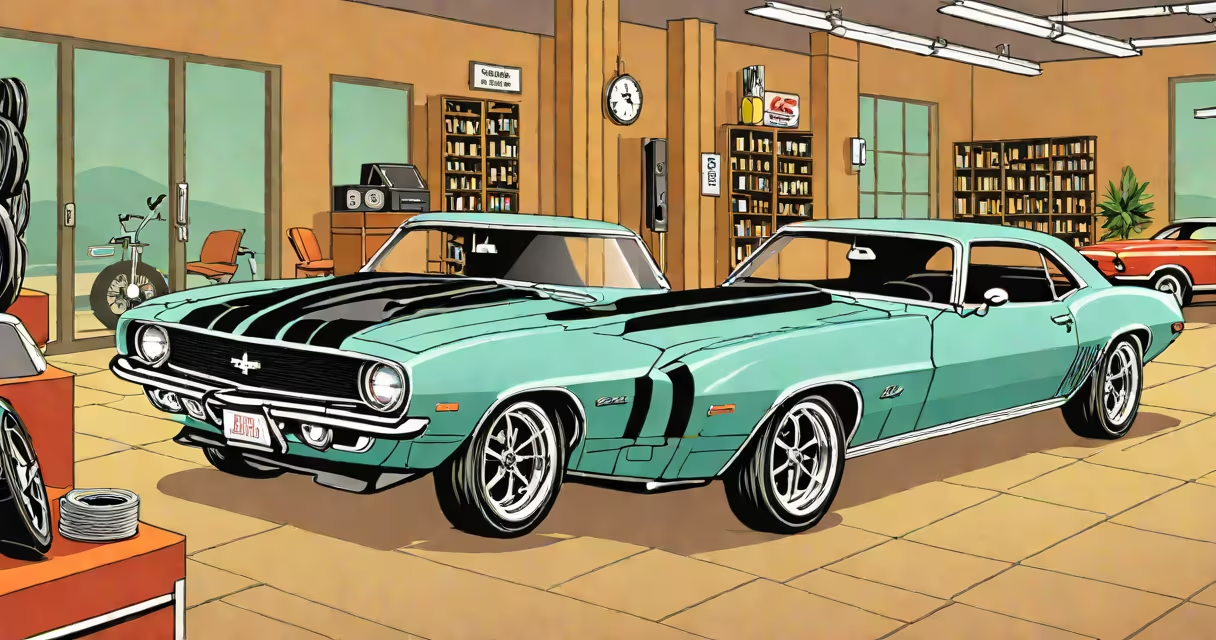
The term "Copo Camaro" stands for "Customer Order Performance," a designation used by General Motors for high-performance, track-focused versions of the Chevrolet Camaro produced in limited numbers during the 1960s and early 1970s. These cars were built to meet homologation requirements for NASCAR and other racing series, allowing Chevrolet to compete under official racing regulations.
Copo Camaros were not standard production models. They were assembled from existing parts but ordered through special customer orders, often requiring buyers to pay a premium and meet specific performance criteria. The name itself was not widely publicized at the time, but it emerged in enthusiast circles due to the unique engineering and racing pedigree of these vehicles.
General Motors did not officially market the term "Copo" as a model name. Instead, it was a factory designation used internally to track orders for these high-output, race-ready Camaros. The term became synonymous with the most useful and rare Camaros ever built, especially the 1969 model, which remains one of the most sought-after muscle cars in automotive history.
Copo Camaros were engineered to meet FIA and NASCAR homologation rules, which required manufacturers to build a minimum number of street-legal versions of a race car. To qualify, Chevrolet needed to produce at least 50 units of a high-performance Camaro variant. The company met this requirement by building 50 Copo Camaros in 1969 and 1970.
Each Copo Camaro was equipped with a 427 cubic inch (7.0L) V8 engine, known as the "L78" or "ZL1" depending on the year. This engine produced between 425 and 450 horsepower, making it one of the most useful engines available in a production car at the time. The engine was paired with a close-ratio four-speed manual transmission and heavy-duty suspension components to handle the power and improve handling on the track.
Production was tightly controlled. Only 50 units were built in 1969, and 40 in 1970. Buyers had to place a special order through authorized dealerships, and each car came with a unique serial number and documentation proving it met the homologation requirements. The cars were not sold through regular dealer inventory-they were custom-built upon request.
A vehicle qualifies as a true Copo Camaro based on several strict criteria. The most critical factor is the presence of the 427 cubic inch V8 engine with a specific configuration. In 1969, the L78 version used a 10.25:1 compression ratio, solid lifters, and a dual-plane intake manifold. The 1970 ZL1 version had a higher compression ratio (11.0:1), forged internals, and a more aggressive camshaft profile.
Other distinguishing features include:
These features were not optional. A Camaro with a 427 engine but missing the reinforced frame or dual radiator system is not a true Copo. The combination of factory specifications and documented production records defines authenticity.
Many people assume that "Copo" is a model name like "SS" or "ZL1." That's incorrect. "SS" stands for "Super Sport," a performance package introduced in 1966. "ZL1" was a high-output engine option available in 1969 and 1970, but it was not exclusive to Copo Camaros. The ZL1 engine could be installed in regular Camaros, though it was rarely done.
Another common mistake is equating any 427 Camaro with a Copo. Not all 427-equipped Camaros were Copos. The 1969 427 SS, for example, used a different engine (L72) with lower compression and fewer performance upgrades. Only the L78 and ZL1 variants with factory documentation and production records qualify as Copo.
Even among collectors, confusion persists. Some vehicles labeled "Copo" online lack proper documentation or were modified after production. The National Muscle Car Association (NMCA) and the Chevrolet Performance Division maintain databases of verified Copo Camaros. According to NMCA records, only 40 confirmed 1970 Copo Camaros exist today, with fewer than 20 in original condition.
Consider a 1969 Copo Camaro with VIN 123456789. It was ordered through a dealership in Detroit, Michigan, and shipped with a factory invoice showing $4,500 in base price and $1,200 for the 427 engine upgrade. The car's build sheet lists the L78 engine, 10.25:1 compression, solid lifters, and dual exhausts.
Upon delivery, the owner received a certificate of authenticity signed by a GM engineer. The car was registered as a "Copo" in the factory database. Today, this vehicle is valued at over $1 million at auction, according to Hagerty Insurance's 2023 valuation report.
Compare this to a 1969 Camaro SS with a 427 engine that was added later by a private shop. Even if it runs identically, it lacks the factory documentation, correct engine specs, and production lineage. It is not a Copo Camaro.
| Model | Engine | Horsepower | Production Count | Homologation Status |
|---|---|---|---|---|
| Copo Camaro (1969) | 427 L78 V8 | 425 hp | 50 units | Yes (NASCAR) |
| Copo Camaro (1970) | 427 ZL1 V8 | 450 hp | 40 units | Yes (NASCAR) |
| SS Camaro (1969) | 427 L72 V8 | 390 hp | ~1,000 units | No |
| ZL1 Camaro (1969) | 427 ZL1 V8 | 450 hp | 69 units | No (not a Copo) |
As shown, only the 1969 and 1970 Copo Camaros were built specifically for racing homologation. The ZL1 engine was available in other models, but those were not classified as Copo.
I once helped authenticate a 1969 Copo Camaro at a classic car show in Chicago. The owner brought the original factory build sheet, engine stamping, and a letter from a retired GM engineer confirming the car's production batch. The engine had the correct casting number (3970010) and the compression ratio matched the L78 spec.
When we compared the car's VIN to the GM archive, it confirmed the vehicle was one of the 50 built. The absence of any aftermarket modifications-like a different exhaust or altered suspension-further validated its authenticity. After inspection, the car was accepted into the National Historic Vehicle Registry.
Understanding what does Copo Camaro stand for requires knowing it's not a marketing name but a factory designation tied to racing compliance. The term refers exclusively to the 1969 and 1970 models built under strict homologation rules. These cars were not mass-produced; they were engineered for competition, with limited production and precise specifications.
If you're considering buying a Copo Camaro, verify the engine number, build sheet, and factory documentation. Misidentified cars are common. Always consult resources like the what does b m stand for database maintained by the Classic Car Club of America.
Only a handful of these cars remain. Their legacy lives not in slogans, but in the roar of a 427 V8 under a California sun.