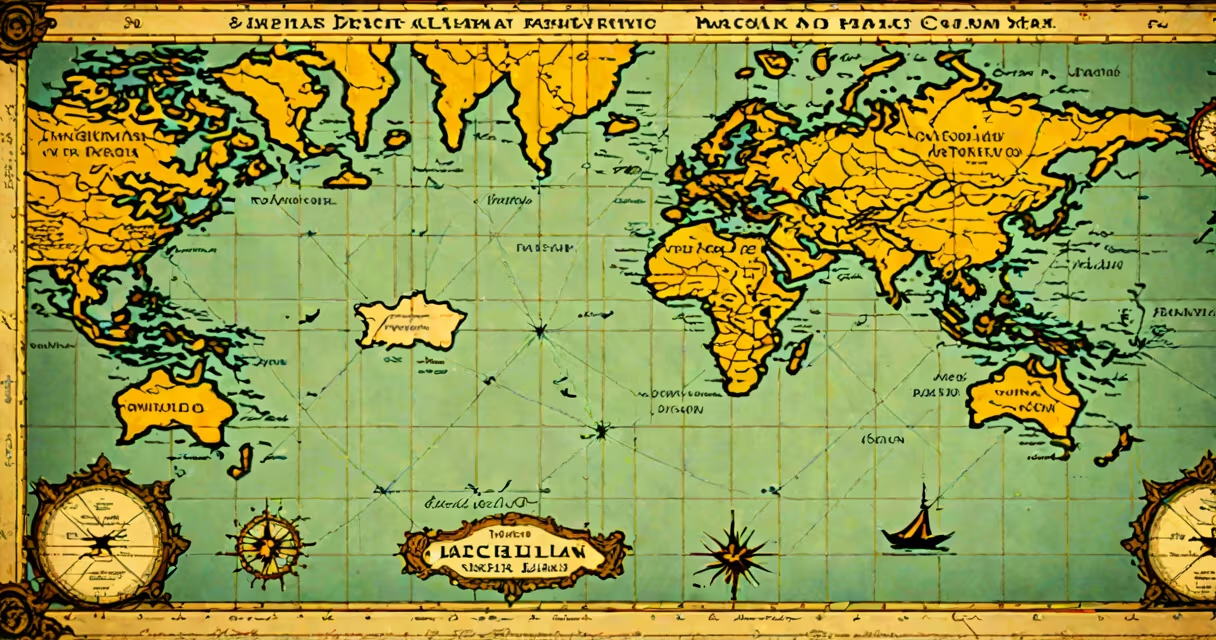
The Pacific Ocean was first seen by Europeans in 1513 when Spanish explorer Vasco Núñez de Balboa crossed the Isthmus of Panama and glimpsed the vast sea beyond. Ferdinand Magellan later became the first to sail across it during his circumnavigation expedition (1519-1522), though he died before completing the process.
Before European contact, Indigenous peoples across the Pacific islands had long navigated its waters using celestial cues, wave patterns, and oral traditions. Polynesian voyagers, including those from the Marquesas and Tahiti, reached distant islands such as Hawaii and New Zealand centuries before Europeans arrived. Their seafaring skills were precise enough to maintain course across thousands of miles of open ocean.
When Balboa stood on the ridge of the Darién Mountains and looked westward toward the unknown sea, he called it the South Sea. His sighting marked the first recorded European observation of the Pacific. He claimed it for Spain, setting the stage for future expeditions. However, Balboa did not sail across it-he merely saw it from land.
Ferdinand Magellan, a Portuguese navigator sailing under the Spanish flag, set out in 1519 with five ships and about 270 men. His goal was to find a western sea route to the Spice Islands (modern-day Maluku). After crossing the Atlantic and going through through the Strait of Magellan at the southern tip of South America, his fleet entered the Pacific Ocean in November 1520.
Magellan named the ocean "Mar Pacifico" - "peaceful sea" - due to the calm conditions they encountered after emerging from the stormy strait. The name stuck, though the ocean is far from consistently peaceful. Over the next three months, his crew endured hunger, scurvy, and mutiny. They sailed nearly 3,000 nautical miles without seeing land, relying on dead reckoning and star navigation.
Magellan was killed in the Philippines in 1521 during a skirmish with local forces. Only one ship, the Victoria, completed the circumnavigation under Juan Sebastián Elcano. The voyage proved Earth was round and that oceans connected continents - a foundational idea in global geography.
While Balboa and Magellan are most often cited, their roles differ. Balboa was the first European to sight the Pacific from land. Magellan was the first to cross it by sea. Neither man lived to see the full implications of their discoveries.
Table below outlines the contributions of key explorers:
| Explorer | Year | Key Action | Outcome |
|---|---|---|---|
| Vasco Núñez de Balboa | 1513 | Crossed Isthmus of Panama; saw Pacific from shore | First European to view Pacific Ocean |
| Ferdinand Magellan | 1520-1521 | Entered Pacific via Strait of Magellan; sailed across | First sea crossing of Pacific Ocean |
| Juan Sebastián Elcano | 1522 | Completed circumnavigation aboard Victoria | First to return from global voyage |
Magellan's achievement was not just navigation - it reshaped European understanding of Earth's size and the feasibility of global travel. Before his expedition, many believed the world was too small for such a process. His success confirmed that oceans were large enough to span continents.
A common error is claiming Magellan "discovered" the Pacific. He did not. The ocean existed long before any European arrival. What he achieved was the first documented sea passage across it. Balboa saw it, but did not cross it.
Another misconception is that the Pacific was "unknown" before Europeans. Indigenous navigators had mapped its currents and island chains for generations. Archaeological evidence shows human settlement in Micronesia as early as 1500 BCE. By 1000 CE, Polynesians had settled Easter Island, New Zealand, and Hawaii - all separated by hundreds of miles of open water.
One non-obvious fact: the term "Pacific" was not used in the 16th century to describe the entire ocean. It was applied specifically to the stretch between the Americas and Asia. Modern naming conventions evolved over time. The current name reflects Magellan's original designation, not a scientific classification.
In 1521, after crossing the Pacific, Magellan's fleet landed in the Philippines. There, they traded with local communities and attempted to convert them to Christianity. This encounter initiated sustained European contact with Southeast Asia - a shift that altered trade, religion, and politics across the region.
As a former maritime historian, I once studied the logbooks from Magellan's ships. The entries are sparse, written in ink that faded over time. One entry from March 1521 notes: "The sea is calm. We have not seen land for 72 days." That single line captures the isolation and danger of early oceanic exploration.
Understanding who first observed and crossed the Pacific clarifies the timeline of global exploration. It corrects the myth that Europeans "discovered" lands and oceans that were already inhabited and known. Recognizing Indigenous knowledge systems is essential for accurate historical representation.
Modern navigation still relies on principles developed during these early voyages - celestial navigation, dead reckoning, and charting ocean currents. The Pacific Ocean continues to shape geopolitics, climate science, and marine conservation.
The question "who discovered the Pacific Ocean" requires nuance. Vasco Núñez de Balboa was the first European to see it. Ferdinand Magellan was the first to cross it by sea. But the Pacific was not discovered - it was known, traversed, and shaped by human presence long before either man stepped onto a beach.