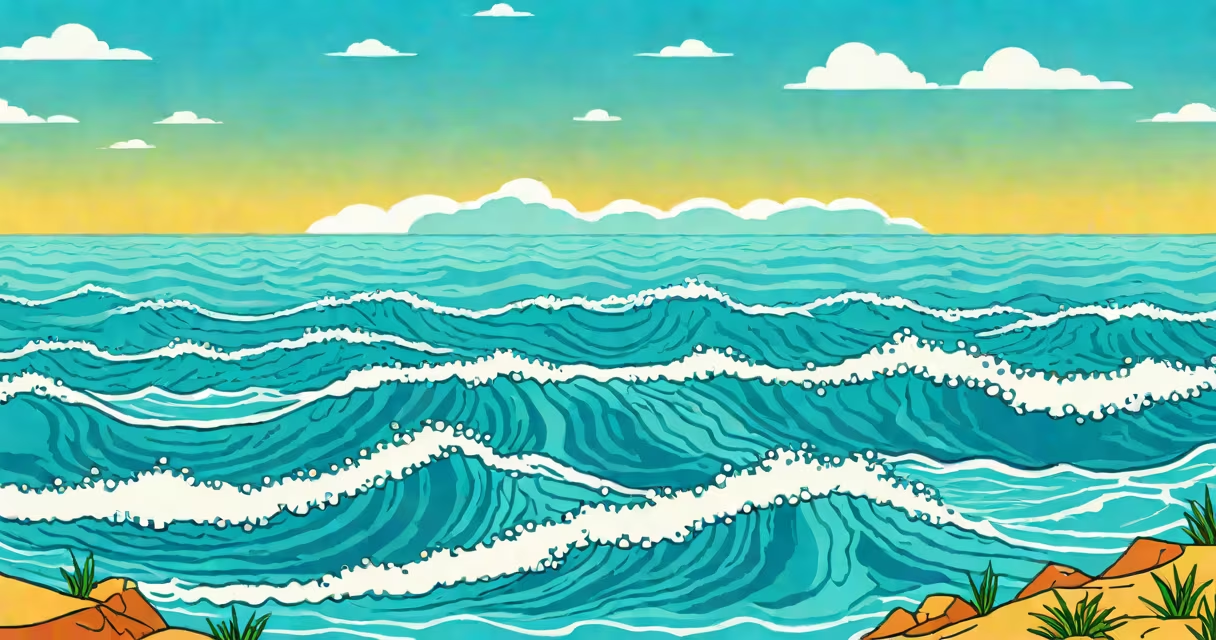
"Mar" in Spanish translates directly to "sea" or "ocean" in English. It refers to large bodies of saltwater, such as oceans, seas, or coastal waters. The term appears in everyday speech, geography, and idiomatic expressions across Spanish-speaking regions.
The word "mar" originates from Latin "mare," which also meant sea. This root appears in many Romance languages, including Italian ("mare") and Portuguese ("mar"). In modern Spanish, "mar" is gendered masculine, though it refers to a natural feature typically associated with fluidity and vastness.
Common phrases using "mar" include "el mar Mediterráneo" (the Mediterranean Sea), "navegar por el mar" (to sail across the sea), and "el mar está en calma" (the sea is calm). These uses reflect both literal and poetic applications.
In daily conversation, "mar" functions as a noun. It appears in travel contexts, weather reports, and emotional metaphors. For example, someone might say, "Voy a la playa porque quiero ver el mar" (I'm going to the beach because I want to see the sea).
Idioms involving "mar" often carry emotional weight. "Tener el mar en el alma" (to have the sea in one's soul) describes a deep connection to the ocean, often linked to people from coastal communities. Another expression, "estar en las nubes y el mar" (to be lost in thought or daydreaming), evokes a sense of drifting away mentally.
Geographic names frequently include "mar." The "Mar Caribe" (Caribbean Sea) spans multiple countries and islands. The "Mar de Bering" (Bering Sea) lies between Alaska and Russia. These names are standardized in official maps and navigation systems.
While "mar" consistently means "sea" in formal and informal Spanish, regional dialects sometimes alter pronunciation or usage. In parts of southern Spain, speakers may use "mar" more poetically, as in "El mar canta" (The sea sings), reflecting local folklore.
A common misconception is confusing "mar" with "marrón," which means "brown." The similarity in sound leads to errors in spoken Spanish, especially among beginners. For example, saying "mi camisa es marrón" (my shirt is brown) instead of "mi camisa es mar" (my shirt is sea-colored) would be nonsensical.
Another confusion arises with "mar" versus "marina." While "mar" refers to the body of water, "marina" means a harbor or dock for boats. A tourist might ask, "¿Dónde está la marina?" (Where is the marina?), expecting a place to moor a boat, not a stretch of ocean.
There are no distinct "types" of "mar" in linguistic classification, but its usage varies by context:
| Context | Example Sentence | Meaning |
|---|---|---|
| Literary | "El mar susurra secretos antiguos." | The sea whispers ancient secrets. |
| Geographic | "El Mar Rojo se extiende entre África y Arabia." | The Red Sea stretches between Africa and Arabia. |
| Emotional/Idiomatic | "Tengo el mar en mis sueños." | I have the sea in my dreams. |
These examples show how "mar" shifts from literal to symbolic. In literature, it often represents mystery, freedom, or danger. In science, it appears in marine biology and oceanography.
For instance, the National Oceanic and Atmospheric Administration (NOAA) uses "mar" in official documents about marine ecosystems. The Spanish version of their website refers to "la conservación del mar" (marine conservation) and "los ecosistemas del mar" (marine ecosystems).
Non-native speakers often misapply "mar" in compound phrases. One frequent error is saying "mar de fondo" to mean "background noise," but this phrase actually refers to the "background sea" or "underlying current" in a metaphorical sense. In finance, "mar de fondo" can describe long-term market trends beneath surface fluctuations.
Another mistake is using "mar" to refer to lakes. While "lago" is the correct term for lake, some learners incorrectly say "el mar del lago" (the sea of the lake). This confuses body types: lakes are freshwater, seas are saltwater. Correct usage: "El lago Titicaca está a más de 3,800 metros sobre el nivel del mar" (Lake Titicaca is over 3,800 meters above sea level).
When describing coastal activities, "mar" is paired with verbs like "nadar" (to swim), "bucear" (to dive), or "pesca" (fishing). For example, "Me encanta bucear en el mar" (I love diving in the sea) correctly places the activity in the intended environment.
I once stayed in a small fishing village in southern Mexico, where locals used "mar" in nearly every conversation. During a festival, a fisherman told me, "Mi vida está ligada al mar" (My life is tied to the sea). He spoke not just about work, but about identity, memory, and survival. That moment clarified how deeply "mar" extends beyond geography-it's cultural, emotional, and historical.
Later, while teaching Spanish, I corrected a student who wrote, "Voy al mar para tomar sol." The correct sentence is "Voy a la playa para tomar sol" (I'm going to the beach to sunbathe). "Mar" refers to the water, not the shore. This distinction matters in real-life communication.
Knowing what "mar" means in Spanish ensures clarity in travel, study, and daily interaction. simply trying to understand a song lyric, recognizing "mar" as "sea" or "ocean" is essential.