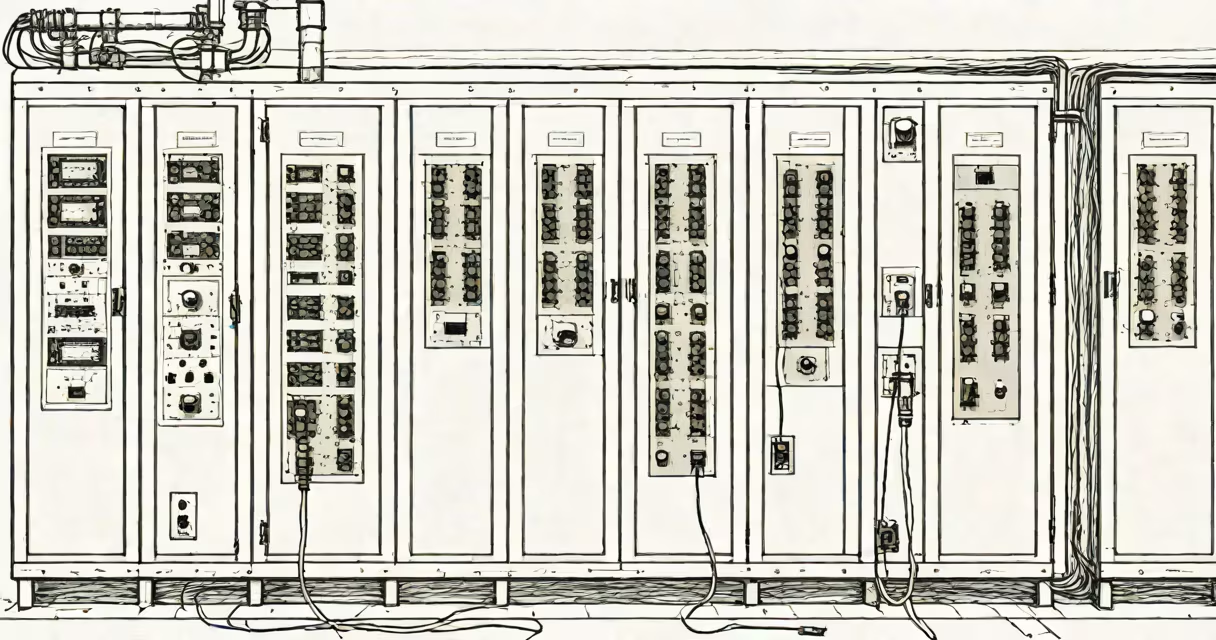
A 3 phase system is an electrical power distribution method that uses three alternating current waveforms, each offset by 120 degrees, to deliver continuous, balanced power. It's the standard for industrial equipment, large motors, and high-demand facilities due to its efficiency and stability.
Unlike single-phase systems that deliver power in pulses, 3 phase provides constant torque and reduces energy loss. This makes it ideal for applications requiring consistent performance, such as manufacturing lines, HVAC systems in commercial buildings, and server farms.
According to the National Electrical Code (NEC), 3 phase systems are required for circuits exceeding 150 amps in commercial and industrial settings. The International Electrotechnical Commission (IEC) also mandates 3 phase for high-power equipment in global standards.
Three phase power relies on three conductors carrying AC voltage that peaks at different times. Each phase reaches its maximum voltage 120 degrees apart-like three waves spaced evenly around a circle. This timing helps at any moment, at least one phase is near peak output.
The result is a steady power flow. In a single-phase system, power drops to zero twice per cycle. In 3 phase, the combined power remains nearly constant, reducing mechanical stress on motors and minimizing voltage fluctuations.
For example, a 3 phase motor running at 60 Hz draws power continuously. A single-phase motor would experience torque dips, leading to vibration and wear. This difference explains why 3 phase drives industrial compressors, pumps, and elevators.
There are two common configurations: wye (Y) and delta (Δ). They differ in wiring and voltage relationships.
| Configuration | Wiring | Voltage Relationship | Use Case |
|---|---|---|---|
| Wye (Y) | Three live wires meet at a central neutral point. | Line-to-neutral voltage = Line-to-line ÷ √3 | Commercial buildings, lighting, and smaller loads. |
| Delta (Δ) | Three wires form a closed loop; no neutral. | Line-to-line voltage = Phase voltage | Industrial motors, high-power equipment. |
Wye systems allow both 120V and 208V outputs from a single setup. For example, a 208V wye system supplies 120V between any phase and neutral-ideal for office outlets and lighting. Delta systems deliver higher line-to-line voltages, such as 480V, which run large industrial machines.
One non-obvious fact: Delta systems don't require a neutral conductor. This saves material and space in industrial panels. However, they can't supply 120V unless a center tap or transformer is added.
3 phase power dominates in environments needing stable, high-capacity energy. Factories use it to run conveyor belts, CNC machines, and robotic arms. Data centers rely on 3 phase to power servers and cooling systems without brownouts.
Consider a 500 kW industrial motor. On single-phase, it would need a 1,000 amp circuit. On 3 phase, it runs on 250 amps per leg-reducing wire size, heat, and installation cost. The NEC notes that 3 phase reduces copper usage by up to 25% compared to single-phase for equivalent power delivery.
Residential homes rarely use 3 phase. Most U.S. homes receive single-phase 120/240V service. But some large homes with electric vehicle chargers, home automation hubs, or workshops may have a 3 phase subpanel.
One common misconception: 3 phase is only for big industries. That's false. Many small businesses-like auto repair shops, breweries, and machine shops-use 3 phase to run tools like welders, grinders, and compressors. These tools draw high startup current, which single-phase can't handle reliably.
People often mistake 3 phase for three separate single-phase circuits. They're not. While each phase can power individual loads, the system operates as a unified whole. The phases are synchronized, and their combined effect produces smoother power delivery.
Another error: thinking 3 phase requires more wires. It doesn't. A 3 phase system can run on just three live wires (delta) or four wires (wye with neutral). Single-phase systems often use two wires (hot and neutral), but still carry less power per wire.
Some assume 3 phase is dangerous because it uses higher voltages. True-480V 3 phase is lethal. But so is 240V single-phase. Safety depends on proper grounding, lockout procedures, and training-not the number of phases.
I once inspected a small machine shop where a technician wired a 3 phase motor to a single-phase outlet using a phase converter. The motor ran, but overheated within 15 minutes. The converter couldn't maintain balance. The solution: install a proper 3 phase panel. This shows that mismatched systems fail under load-even if they seem to work initially.
At a medium-sized automotive parts factory, the main electrical service is 480V 3 phase wye. The system includes:
Power distribution splits into zones:
This setup supports 120 kW of continuous load with minimal voltage drop. A single-phase alternative would require larger cables, more breakers, and frequent overloads during peak production.
3 phase systems deliver efficient, stable power through three synchronized AC waveforms. They're foundational in industry, data infrastructure, and high-load environments. Their design minimizes losses, supports heavy machinery, and enables scalable energy distribution.