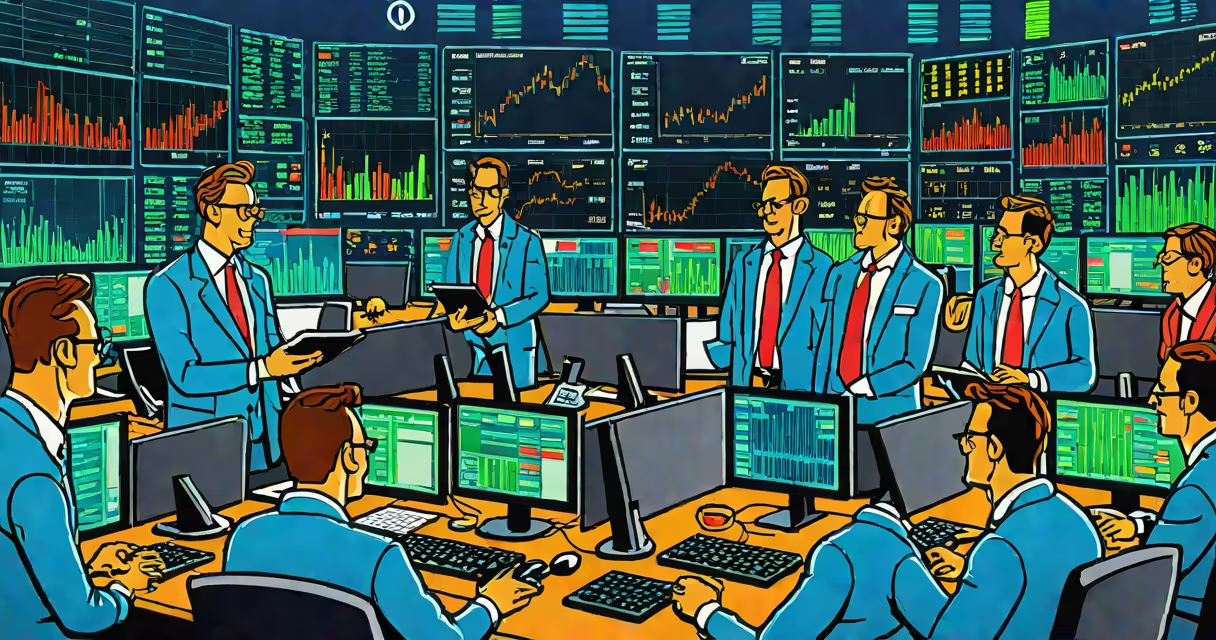
The stock market is shaped primarily by institutional investors, algorithmic trading systems, and large financial firms that collectively manage trillions in assets and execute high-frequency trades. These entities set price movements through volume, timing, and strategic positioning rather than individual retail decisions.
Control in the stock market doesn't reside in a single person or entity. Instead, it emerges from concentrated ownership, advanced technology, and coordinated behavior among useful institutions. The largest mutual funds, pension funds, hedge funds, and asset managers operate with scale and speed that dwarf individual investor activity. For example, BlackRock, Vanguard, and State Street collectively manage over $20 trillion in assets globally, according to the U.S. Securities and Exchange Commission (SEC) filings and public disclosures.
Algorithmic trading accounts for approximately 70% of daily equity volume on U.S. exchanges, as reported by the Federal Reserve Bank of New York in 2022. These systems process news, earnings reports, and market sentiment in milliseconds, adjusting orders automatically. High-frequency traders (HFTs) often profit from microsecond advantages in data transmission, placing them at the center of execution control. This technological edge allows them to absorb liquidity and influence short-term price action.
Institutional investors dominate ownership stakes across major indexes. As of 2023, the top 10 U.S. mutual and exchange-traded funds held over 40% of the S&P 500's total market capitalization, according to Morningstar research. Their collective voting power during shareholder meetings shapes corporate governance, board appointments, and executive compensation policies. When these funds align on proxy votes, they can force changes in company strategy or leadership.
For example, in 2021, a coalition of institutional shareholders-including BlackRock and Vanguard-voted against the CEO of ExxonMobil due to climate risk concerns. The vote passed with 61% support, leading to the eventual resignation of the CEO. This demonstrated how institutional voting power can override management decisions despite opposition from company leadership.
Algorithmic systems further amplify control. A single algorithm can place thousands of orders per second based on predefined rules. During the 2010 Flash Crash, a single automated trade triggered a cascade of sell orders that dropped the Dow Jones Industrial Average by nearly 1,000 points in under five minutes. The SEC later traced the event to a programmatic trade executed by a firm using a flawed algorithm. This incident underscored how automated systems, operating independently of human oversight, can destabilize markets at scale.
Many assume that a single billionaire or secretive group controls the market. While individuals like Warren Buffett or Elon Musk have significant influence on specific stocks, their impact remains limited to particular companies or sectors. Buffett's Berkshire Hathaway owns stakes in companies like Apple and Coca-Cola, but his holdings represent less than 1% of total U.S. market capitalization. His influence is strategic, not systemic.
Another misconception is that retail investors can counterbalance institutional power. While platforms like Robinhood have increased participation, retail traders still account for less than 10% of daily trading volume. During the GameStop short squeeze in early 2021, retail investors coordinated via Reddit forums to drive up share prices. However, the surge was quickly reversed as institutions sold off positions and short sellers re-established control. The episode highlighted the limits of retail coordination against institutional capital and infrastructure.
A lesser-known fact: market makers-firms responsible for maintaining bid-ask spreads-are often the actual gatekeepers of liquidity. They don't just help trades; they determine whether a trade executes at all. In 2020, the SEC found that certain market makers manipulated small-cap stock spreads by placing and canceling orders rapidly, creating artificial volatility. This practice, known as "spoofing," is illegal but persists due to regulatory gaps in real-time monitoring.
| Type of Control | Primary Actors | Method of Influence | Real-World Example |
|---|---|---|---|
| Ownership-Based | Asset managers, pension funds | Shareholder voting, long-term holding | BlackRock's 2022 proxy vote against Amazon's board over labor practices |
| Execution-Based | High-frequency traders, market makers | Order placement speed, latency arbitrage | 2010 Flash Crash triggered by a single algorithmic trade |
| Data-Based | Quant funds, AI-driven hedge funds | News sentiment analysis, alternative data feeds | Two Sigma uses satellite imagery to predict crop yields and trade agricultural futures |
Each mechanism operates independently but converges in effect. Ownership gives long-term use. Execution speed enables short-term advantage. Data access fuels predictive models. Together, they form a multi-layered system of control that is decentralized yet effective.
I once watched a live feed of the Nasdaq ticker during a quarterly earnings announcement. Within 14 seconds of the report being released, algorithmic systems had adjusted prices by 3%. The movement wasn't driven by human interpretation-it was a direct response to pre-programmed triggers analyzing the text of the earnings call. The actual human traders in the room were reacting to the change, not initiating it.
This moment clarified that control isn't visible in headlines or social media debates. It happens in microseconds, behind firewalls, and in code. The people who appear on CNBC are often responding to events they didn't cause. The real decision-making occurs in data centers and server farms, not boardrooms.
Understanding who is controlling the stock market requires shifting focus from personalities to systems. It's not about identifying a villain or a mastermind. It's about recognizing that control is distributed across institutions, algorithms, and infrastructure-with outcomes shaped by scale, speed, and access to information.
who is controlling the stock market