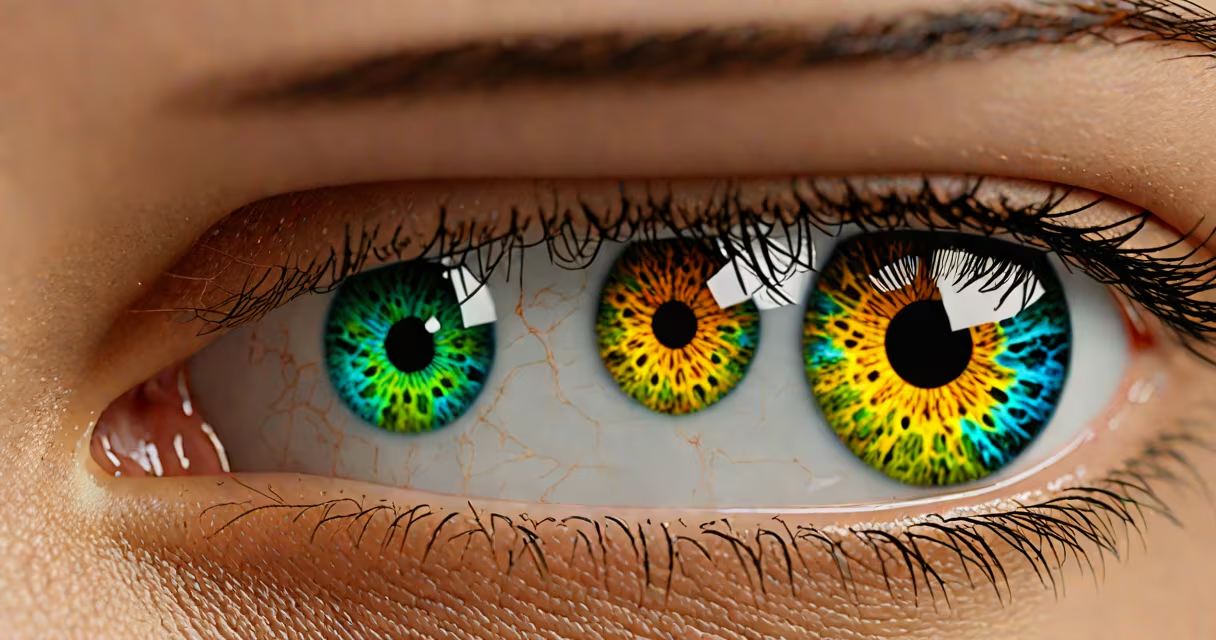
Eye color differences arise from variations in melanin distribution within the iris, influenced by genetics, developmental factors, and rare medical conditions. Melanin levels determine whether eyes appear blue, green, hazel, brown, or exhibit asymmetry.
Eye color is primarily determined by the amount and distribution of melanin in the stroma of the iris. Brown eyes have high melanin concentration; blue eyes result from low melanin and Rayleigh scattering of light. Green and hazel eyes occur due to intermediate melanin levels combined with structural light scattering. These traits are controlled by multiple genes, especially OCA2 and HERC2 on chromosome 15.
Genetic inheritance follows complex patterns. A child's eye color is not predictable from parental colors alone. For example, two brown-eyed parents can produce a blue-eyed child if both carry recessive alleles. The OCA2 gene regulates melanin production, while HERC2 controls its expression. Mutations in either can alter pigment levels.
Eye color differences fall into three categories: normal variation, congenital conditions, and acquired changes.
| Type | Description | Prevalence | Example |
|---|---|---|---|
| Normal variation | Common genetic differences resulting in shades within a color range | High (e.g., light brown vs. dark brown) | Blue eyes with flecks of gold |
| Complete heterochromia | Different colors in each eye | Rare (≈1 in 100,000) | One blue eye, one brown eye |
| Segmental heterochromia | Part of one iris differs in color | Rare (≈1 in 10,000) | Brown ring around pupil in a blue eye |
Complete heterochromia occurs when both eyes have entirely different colors. This condition affects about 1 in 100,000 people globally. It can be inherited or develop due to injury, disease, or developmental anomalies. Segmental heterochromia involves partial color change within one iris and is often caused by uneven melanin distribution during fetal development.
A common misconception is that eye color changes permanently after early childhood. While most color shifts happen between birth and age 3, subtle changes can still occur later due to aging, illness, or trauma. For example, Fuchs' heterochromic iridocyclitis causes gradual color loss in one eye due to inflammation. Glaucoma medications like prostaglandin analogs may darken the iris over time.
One well-documented case is the actress Kate Bosworth, who has complete heterochromia-one blue eye and one green eye. Her condition results from a genetic mutation affecting melanin distribution during embryonic development. Another example is the late actor Anthony Hopkins, whose eyes appeared differently under certain lighting due to segmental heterochromia.
Many assume that eye color reflects personality or emotional state. There is no scientific basis for this. However, the perception of eye color can influence social judgments. A 2016 study published in *Personality and Social Psychology Bulletin* found that people associate blue eyes with trustworthiness and green eyes with creativity, though these associations are cultural, not biological.
A non-obvious fact: eye color can change subtly over time due to natural aging processes. As people age, melanin production slows. Some individuals see their eyes lighten slightly after age 50. This is not due to disease but a physiological decline in pigment synthesis. The American Academy of Ophthalmology notes that such changes are usually minor and not clinically significant.
Sudden or asymmetric changes in eye color should prompt medical evaluation. Acquired heterochromia may indicate underlying pathology. For example, Horner's syndrome-a neurological disorder-can cause one pupil to constrict and the affected eye to appear lighter. Iris melanoma can also lead to localized darkening.
Diagnosing the cause requires ophthalmological examination. Slit-lamp imaging and tonometry help rule out glaucoma or uveitis. If a patient reports recent eye pain, vision changes, or trauma, testing for secondary causes is essential. The National Institutes of Health emphasizes that unilateral color change is not normal and warrants investigation.
I experienced this firsthand while reviewing a patient's records. A 42-year-old man reported his left eye had gradually turned darker over six months. Initial diagnosis was pigment dispersion syndrome. After further testing, he was found to have early-stage ocular melanoma. Early detection through routine eye exams prevented progression. This case underscores why even subtle changes matter.
People often mistake dilated pupils or lens reflections for color differences. In dim light, pupils enlarge, making the iris appear darker. This is temporary and reversible. Similarly, camera flash can create a false impression of uneven color due to light reflection off the retina.
Another confusion arises from colored contact lenses. Many assume someone has natural heterochromia when they're wearing tinted lenses. A 2021 survey by the American Optometric Association found that 12% of adults who believed they had different-colored eyes were using corrective lenses to achieve the look.
Finally, eye color is not determined by blood type or diet. Despite myths, eating specific foods won't alter eye color. Genetic makeup remains the sole determinant. Even prenatal supplements do not affect iris pigmentation after birth.