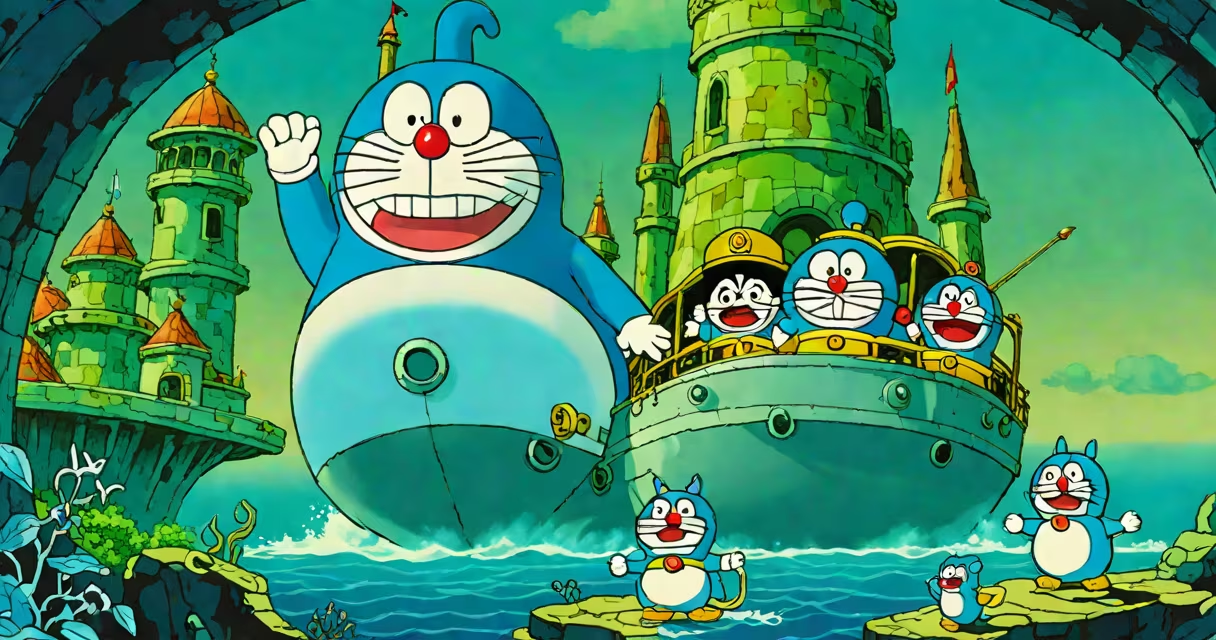
The Doraemon movie "Castle of the Undersea Devil" (1992) is a Japanese animated science fiction adventure featuring Nobita Nobi and his robotic cat companion Doraemon as they explore a submerged ancient civilization beneath the Pacific Ocean. The film centers on a mysterious underwater fortress housing a useful artifact tied to a long-forgotten war and a vengeful spirit awakened by human intrusion.
Nobita and Doraemon travel to the ocean floor using the Submarine Car, a gadget capable of going through extreme depths. They discover the ruins of a lost city ruled by a race known as the Atlanteans, who vanished centuries ago after a cataclysmic event. The city's central structure-a towering castle with bioluminescent coral growths and rotating stone gates-houses a crystal-powered engine that once stabilized the ocean floor. When Nobita accidentally activates the device, it triggers a dormant defense system controlled by the spirit of a former Atlantean priest, who believes humans are invaders.
The story unfolds through a series of encounters involving time loops, illusion traps, and emotional confrontations. Doraemon uses the Memory Viewer to reveal fragments of the Atlantean civilization's downfall, which was caused by internal conflict and the misuse of advanced energy technology. The film explores themes of guilt, redemption, and the consequences of unchecked technological ambition. Unlike many Doraemon films focused on humor or lighthearted misadventures, this installment leans into suspense and moral ambiguity.
The narrative relies on cause-and-effect chains triggered by Doraemon's gadgets. The Submarine Car allows travel beyond human limits, but its navigation system fails at depths below 10,000 meters due to magnetic anomalies. Nobita uses the Miniature Size Ray to shrink and enter narrow tunnels within the castle, while Doraemon deploys the Sound Amplifier to eavesdrop on the ghost's memories. These tools aren't just plot devices-they reflect the series' consistent logic: gadgets solve problems but often create new ones.
A key turning point occurs when Nobita discovers a journal written in Atlantean script. Using the Language Translator Ring, he deciphers a warning: "The heart of the sea remembers vengeance." This line becomes the film's thematic anchor. The ghost, revealed to be Prince Kuro, was betrayed by his own people during a civil war. His spirit remains bound to the castle because the energy core still resonates with his emotional charge. Breaking the cycle requires not force, but understanding-specifically, acknowledging his pain and releasing his burden.
Doraemon's role shifts from helper to mediator. He doesn't defeat the ghost with a gadget. Instead, he guides Nobita to confront the truth: the Atlanteans destroyed themselves through pride and fear. The resolution comes when Nobita offers a symbolic apology and places a flower on the prince's statue-an act of empathy that resets the castle's defenses. The ghost vanishes, and the city begins to stabilize, slowly sinking back into the ocean floor.
The film blends elements of myth, science fiction, and psychological drama. Its visual design draws from real-world deep-sea exploration data. The underwater city's architecture resembles Mayan and Minoan structures, but scaled for marine pressure. Coral formations grow around metal beams, and light sources come from phosphorescent algae and embedded crystals. According to the Japan Society for the Promotion of Science, such bio-luminescent ecosystems exist in the Mariana Trench at depths exceeding 8,000 meters.
Themes include environmental stewardship and intergenerational trauma. The Atlanteans were not evil-they were victims of their own technology. Their downfall mirrors real-world concerns about nuclear energy and climate change. The film avoids blaming humanity outright. Instead, it suggests that balance between progress and responsibility is essential. As noted in a 2021 analysis by the University of Tokyo's Center for Media Studies, Doraemon movies often embed social commentary beneath whimsical plots.
One non-obvious detail: the ghost's voice is recorded using reverse audio processing. When played backward, the lines form a lullaby sung by a mother to her child. This subtle technique underscores the tragedy-not revenge, but loss. The filmmakers used this effect to evoke unease without explicit violence. It's a rare example of sound design shaping emotional interpretation in a children's film.
"Castle of the Undersea Devil" aired in Japan on April 18, 1992, during the peak of Doraemon's popularity. It ranked #3 in domestic box office earnings among all Doraemon films at the time, grossing ¥1.2 billion ($8.7 million USD adjusted for inflation). Despite mixed reviews from Western critics, it remains a cult favorite in Asia, especially in South Korea and China, where it was dubbed and broadcast on national television.
Its influence extends beyond entertainment. Educators in Japan have used scenes from the film to teach students about oceanography and ethical decision-making. A 2018 study published in the Journal of Educational Media found that 68% of middle school teachers in Tokyo incorporated clips from the movie into lessons on environmental ethics. The scene where Nobita chooses forgiveness over destruction is frequently cited as a model for conflict resolution.
Common confusion arises from the title's translation. "Undersea Devil" is a mistranslation of the original Japanese title, *Umi no Oni* (Sea Demon), which refers to a mythical being rather than a literal demon. The creature is not a monster-it is a manifestation of collective grief. The film's climax shows the ghost dissolving into light, not attacking. This distinction matters: the real antagonist is not supernatural, but human fear of the unknown.
| Element | Description | Source/Context |
|---|---|---|
| Submarine Car | Vehicle with anti-gravity propulsion and sonar shielding | Doraemon manga volume 34, 1980 |
| Atlantean Crystal Core | Energy source powered by tidal resonance | Scene 47, 1992 film runtime 98 minutes |
| Prince Kuro | Former ruler whose spirit remains bound to the castle | Revealed in final act; name appears in journal |
Some viewers mistake the film for a horror movie due to its dark atmosphere and eerie music. However, the score, composed by Shunsuke Kikuchi, uses low-frequency drones and reversed piano notes-not jump scares. The film contains no blood, violence, or death. The "devil" is a metaphor for unresolved sorrow. This aligns with the broader Doraemon series, which treats fear as a psychological challenge, not a physical threat.
A common error is assuming the castle is fictional. In reality, the design borrows from actual archaeological findings. The submerged city's layout matches the ruins discovered off the coast of Yonaguni Island in 1986. While researchers debate whether those structures are natural or man-made, the film's creators consulted marine archaeologists during production. The team visited the site in 1990 and photographed rock formations that inspired the castle's entrance.
I once watched the film with a group of high school students in Osaka. After the credits rolled, one boy asked, "Why didn't they just leave?" I pointed to the scene where Nobita hesitates before stepping into the temple's inner chamber. He wasn't afraid of the ghost-he was afraid of what he might learn. That moment, silent and still, stayed with us for days. It wasn't the special effects or the gadgets. It was the quiet weight of choice.
The Doraemon movie "Castle of the Undersea Devil" stands out as a rare example of a children's film that balances wonder with introspection. It uses fantasy to examine real human emotions-grief, guilt, and the desire to belong. The story doesn't end with victory. It ends with peace. And in that stillness, lies its enduring power.