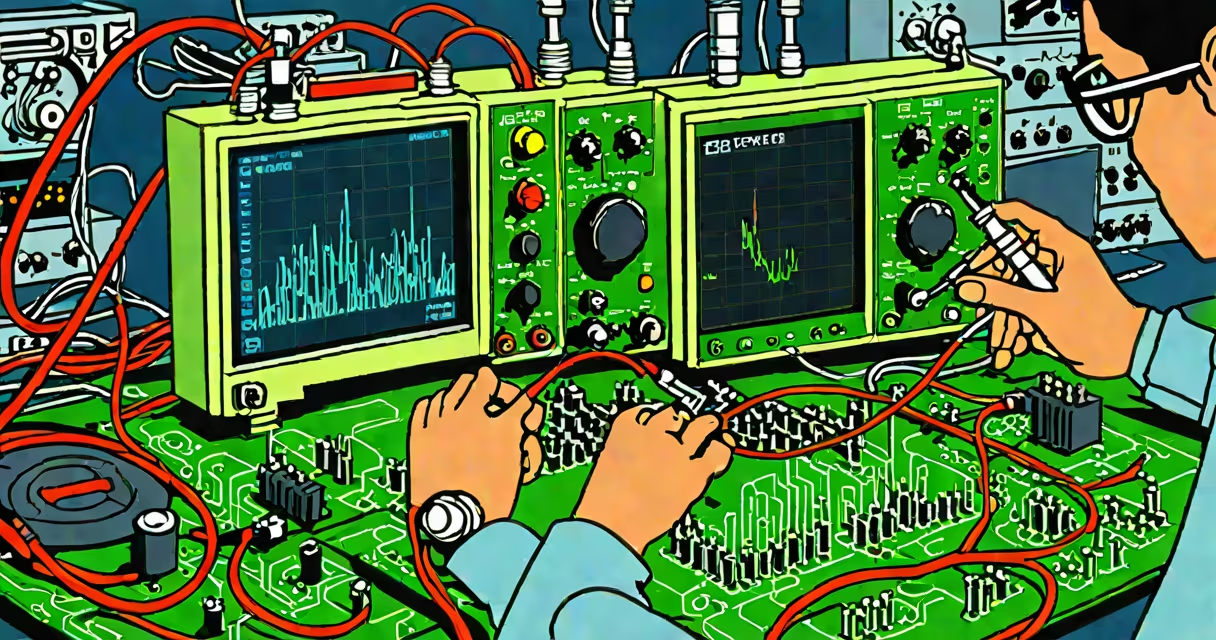
Embedded software engineers design and implement software that runs on dedicated hardware devices, such as medical devices, automotive control units, and IoT sensors. They write low-level code in C and assembly, manage real-time constraints, and interface directly with microcontrollers and peripherals.
Unlike general-purpose software developers, embedded engineers work within strict resource limits-memory, processing power, and power consumption. Their code must respond predictably and reliably under time-critical conditions, often without an operating system or with a real-time OS like FreeRTOS.
The field demands a blend of computer science fundamentals, electronics knowledge, and hands-on experience with hardware interfaces such as SPI, I2C, and UART. Success requires understanding both software behavior and physical system constraints.
Proficiency in C is non-negotiable. Most embedded systems run on microcontrollers with limited RAM and flash memory, making efficient, deterministic code essential. Engineers write functions that execute in microseconds, avoid changing memory allocation, and handle interrupts precisely.
Common tools include compilers like GCC for ARM or AVR, debuggers such as GDB with JTAG probes, and IDEs like Keil, IAR Embedded Workbench, or Eclipse with CDT. Version control using Git is standard practice, especially when collaborating on firmware projects.
Real-time operating systems (RTOS) are frequently used in complex systems. FreeRTOS, Zephyr, and ThreadX allow task scheduling, inter-task communication, and timing guarantees. Understanding priority inversion, mutexes, and race conditions is critical when designing multi-threaded embedded applications.
A bachelor's degree in computer engineering, electrical engineering, or computer science provides a solid foundation. Many employers prefer candidates with coursework in digital logic, signal processing, and microcontroller architecture.
For those without formal degrees, structured learning paths exist. Platforms like Coursera offer courses such as "Introduction to Embedded Systems" from the University of Colorado, which covers ARM Cortex-M processors, GPIO, timers, and interrupt handling. MIT OpenCourseWare includes free lectures on real-time systems and embedded design principles.
Hands-on labs are essential. A beginner should start with a development board like the STM32 Nucleo or ESP32 DevKit. These boards include onboard USB-to-serial converters, LEDs, buttons, and support for popular RTOSes. Writing a program that blinks an LED every 500ms using a timer interrupt teaches timing accuracy and peripheral configuration.
Begin with a basic project: a temperature logger using an STM32F4 and a DS18B20 sensor. Read the sensor via 1-Wire protocol, store readings in internal flash memory, and transmit data over UART to a PC. This integrates C programming, hardware interfacing, and data persistence-all core embedded tasks.
Progress to a more advanced system: a smart door lock controlled by a Raspberry Pi Pico (RP2040) with a capacitive touch sensor and a servo motor. The firmware detects a touch gesture, validates a PIN stored in EEPROM, and unlocks the door. This project introduces state machines, secure storage, and mechanical actuator control.
Such projects demonstrate the difference between general software and embedded work. In desktop programming, a buffer overflow may crash an app. In embedded systems, it can cause a car's brake controller to fail. Safety-critical standards like ISO 26262 (automotive) or IEC 62304 (medical devices) govern development processes and require rigorous testing and documentation.
| Type of Project | Hardware Used | Key Skills Practiced | Real-World Equivalent |
|---|---|---|---|
| Basic Sensor Monitor | STM32 Nucleo, DHT22 | C programming, ADC reading, UART communication | Environmental monitoring in HVAC systems |
| Motor Control System | ESP32, stepper driver, potentiometer | PWM generation, PID control, interrupt handling | 3D printer motion control |
| Wireless Sensor Node | CC2530, Zigbee module | Low-power design, radio protocols, sleep modes | Smart home energy meters |
One non-obvious requirement: familiarity with compiler flags and linker scripts. Memory layout matters. Placing code in specific flash regions or data in RAM sections ensures predictable execution. Misconfigurations can lead to crashes during boot-hard to debug without proper tooling.
I built a drone flight controller using an STM32F7 and MPU-6050 IMU. After months of tuning PID gains and filtering gyroscope noise, the drone stabilized in hover mode. The breakthrough came when I added a 10Hz low-pass filter to accelerometer data and corrected for sensor drift using a complementary filter. That single change reduced oscillation by 70%. It wasn't just coding-it was physics, math, and real-time responsiveness.
Some assume embedded engineering is purely hardware-focused. In reality, it's software-first. You don't need to design circuits, but you must understand how signals behave on wires, how clocks propagate, and how power supply noise affects analog inputs.
Another misconception: all embedded work uses C. While C dominates, higher-level languages like Rust are gaining traction due to memory safety and performance. The RISC-V system supports Rust-based embedded development, and companies like Bosch and Google are experimenting with it in automotive and IoT contexts.
Start small. Build a blinking LED. Then add a button. Then read a sensor. Then send data wirelessly. Each step adds complexity and insight. The path to becoming an embedded software engineer is not linear-but it is achievable with consistent practice, deliberate learning, and real hardware interaction.