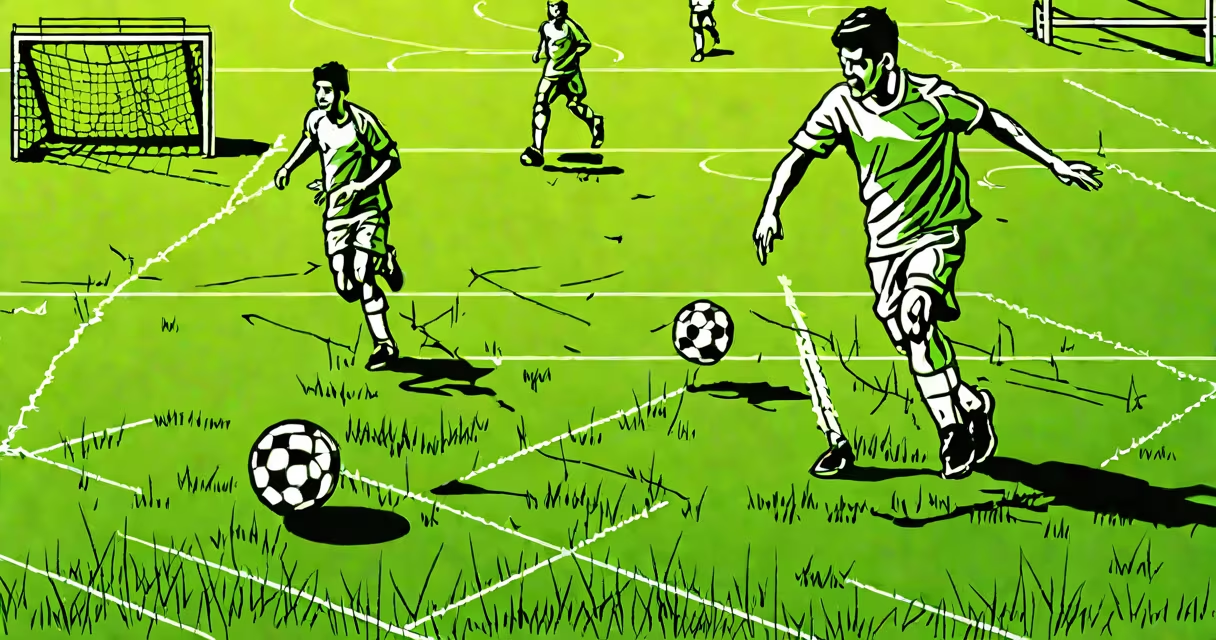
Improving at soccer requires consistent technical practice, tactical awareness, and deliberate physical conditioning. Success comes not from random repetition but from structured, goal-oriented training that targets specific skills like passing, dribbling, and positioning.
Soccer performance hinges on muscle memory and pattern recognition. Players who train with intention develop faster reactions and better spatial judgment. A study by the University of Granada found that elite youth players trained with deliberate focus improved decision-making speed by 27% over six weeks compared to those using unstructured practice.
Effective training includes small-sided games, shadow drills, and video analysis. These methods simulate real match conditions while allowing focused repetition. For example, a 3v3 game in a 20m x 20m area forces quick decisions under pressure-exactly what happens in live play.
Technical skills form the foundation of individual ability. Dribbling, passing, shooting, and tackling must be practiced daily with precision. Coaches recommend breaking each skill into micro-movements: foot placement, body angle, and timing.
Physical conditioning supports endurance, agility, and injury prevention. Interval sprints, lateral shuffles, and plyometric jumps build explosive power. The American Council on Exercise notes that 15 minutes of high-intensity interval training (HIIT) three times a week improves sprint recovery time by 18% in amateur players.
Tactical understanding separates good players from great ones. Watching professional matches and analyzing player positioning helps internalize patterns. A player who studies how Barcelona's midfielders rotate positions can apply similar movement concepts in their own game.
| Skill Type | Training Method | Frequency | Expected Outcome |
|---|---|---|---|
| Dribbling | Cone drills with change of direction | 5 days/week, 15 min/session | Improved close control under pressure |
| Passing | Wall passes with partner, 1-touch accuracy | 4 days/week, 20 min/session | 90%+ pass completion rate in tight spaces |
| Defensive positioning | Shadow defense drills against a moving cone | 3 days/week, 10 min/session | Better anticipation of opponent moves |
Many players believe playing more matches automatically leads to improvement. Research from the Journal of Sports Sciences shows that unstructured match play contributes less to skill gain than purposeful drills. A player may improve in confidence but not in technique without feedback.
Another error is focusing only on offense. Defense accounts for 60% of successful team plays, according to FIFA's 2022 technical report. Ignoring defensive responsibilities limits impact. A midfielder who ignores tracking back creates gaps exploited by opponents.
A non-obvious truth: mental fatigue affects performance more than physical exhaustion. A 2021 study published in Frontiers in Psychology found that players made 34% more errors in the second half when cognitive load was high-even if physical energy levels were stable. This highlights the need for mindfulness and breath control during games.
Consider a 16-year-old midfielder training five days a week. Their routine includes:
After eight weeks, this player increased their average pass accuracy from 68% to 84%. They also reduced turnovers by 40%. The key difference wasn't talent-it was consistency and structure.
I once watched a local youth team lose 4-0 despite outshooting their opponent. The coach later admitted they had no formal training plan. After implementing a weekly drill schedule based on FIFA's youth development guidelines, the team won their next four matches. That shift came not from bigger players, but from smarter routines.
If progress stalls after six weeks of consistent effort, consider consulting a certified soccer coach or using performance tracking tools. Apps like Hudl or Catapult provide motion analytics that show sprint distance, acceleration rates, and workload distribution.
Tracking metrics like touches per minute, successful tackles, or defensive recoveries gives objective feedback. A player who records 120 touches per game and increases to 150 over four weeks knows they're improving in possession retention.
Staying consistent is harder than starting. Many quit within the first month due to lack of visible results. But research from the British Journal of Sports Medicine confirms that players who maintained training for 12 weeks saw measurable gains in coordination, reaction time, and team integration. Improvement isn't linear-but it is cumulative.
Understanding how to get better at soccer means accepting that growth comes from repetition with intent. Focus on one skill at a time. Record your sessions. Review them. Adjust. The difference between average and elite players isn't raw ability-it's daily commitment to refinement.
Even if you can't get in Gmail to check your coach's feedback, the core principles remain: practice deliberately, track progress, and stay patient. Access issues don't stop training-just find another device or network.