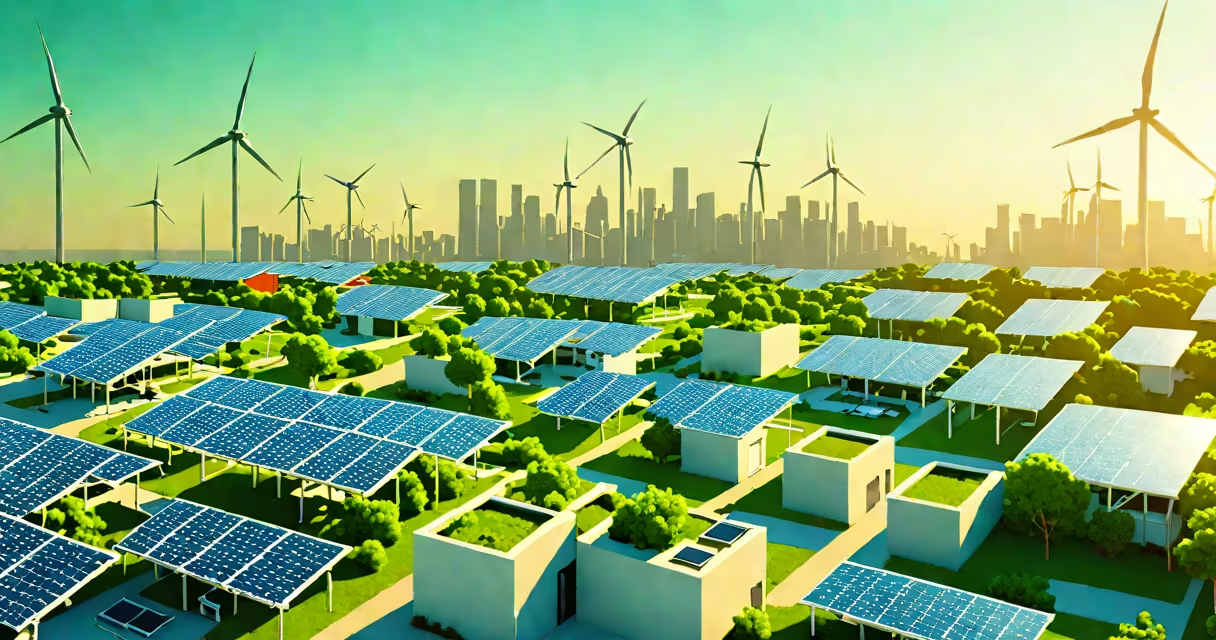
Sustainability means meeting today's needs without reducing the ability of future generations to meet theirs. It balances environmental protection, economic growth, and social well-being across time. This concept applies to ecosystems, economies, and human systems alike.
The idea emerged from ecological science and gained global traction after the 1987 Brundtland Report, which defined sustainability as "development that meets the needs of the present without compromising the ability of future generations to meet their own needs." The report was produced by the World Commission on Environment and Development, a UN-backed body. Its structure remains central to international policy.
Sustainability is not a single goal but a set of interdependent principles. It requires managing resources so they regenerate faster than they're consumed. It demands fairness in access to clean water, food, energy, and opportunity. It also involves long-term planning in infrastructure, agriculture, and urban design.
Sustainability operates through feedback loops between human activity and natural systems. For example, planting trees in deforested areas restores carbon absorption capacity. Reusing industrial waste reduces landfill burden and conserves raw materials. These actions slow degradation and maintain system resilience.
A practical example is the city of Copenhagen's district heating system. It recycles waste heat from power plants and industries to warm homes. The system captures 90% of available heat that would otherwise be lost. As a result, Copenhagen reduced its CO₂ emissions by 60% between 1995 and 2020 while maintaining high living standards. This model shows how technical innovation and policy integration enable sustainable outcomes.
Another example is regenerative agriculture. Farmers using cover crops, crop rotation, and minimal tillage rebuild soil organic matter. A 2021 study by the Rodale Institute found that such farms sequestered 1.8 tons of carbon per hectare annually-equivalent to removing 40 cars from the road per farm each year. This proves sustainability can deliver measurable environmental benefits.
Sustainability is often broken into three pillars: environmental, economic, and social. These are not isolated-they interact constantly.
| Pillar | Focus Area | Real-World Example |
|---|---|---|
| Environmental | Resource conservation, biodiversity, pollution reduction | Costa Rica's national park system protects 25% of its land and supports ecotourism revenue |
| Economic | Long-term profitability, fair labor, resilient supply chains | Patagonia's "Worn Wear" program repairs and resells used clothing, extending product life by 300% |
| Social | Equity, health, education, community participation | Medellín, Colombia, built cable cars and libraries in informal settlements, cutting crime rates by 40% in targeted zones |
Some organizations use a four-ply model adding governance and culture. The United Nations Sustainable Development Goals (SDGs) reflect this expanded view. Goal 13 calls for urgent climate action. Goal 12 promotes responsible consumption and production. These goals are backed by data from the UN Department of Economic and Social Affairs and the World Bank.
One common mistake is treating sustainability as purely environmental. But a factory that cuts emissions but exploits workers fails the social pillar. Similarly, a business profitable today but depleting groundwater won't survive long-term. True sustainability requires trade-off analysis across all dimensions.
Sustainability guides decisions in cities, corporations, schools, and households. Urban planners use it to design walkable neighborhoods with mixed-use zoning. This reduces car dependency and lowers emissions. The city of Freiburg, Germany, built solar-powered housing districts that generate more energy than they consume-proving urban sustainability is achievable at scale.
Corporations adopt sustainability to reduce risk and build brand trust. Unilever's Sustainable Living Plan reduced water use by 50% across its factories between 2008 and 2018. The company reported a 15% increase in customer loyalty during that period. Internal audits showed that sustainability investments improved supply chain stability and lowered compliance costs.
Individuals apply sustainability through daily habits. Reducing meat consumption by half cuts personal carbon footprint by 15%, according to a 2020 study published in *Nature Food*. Switching to public transit or biking for short trips avoids 1.5 tons of CO₂ per person annually. These changes are small individually but cumulatively significant.
Sustainability is often mistaken for "going green" or "being eco-friendly." But those terms focus only on environmental aspects. Sustainability includes justice, equity, and long-term viability. A project may use recycled materials but still displace communities-making it unsustainable despite green branding.
Another error is assuming sustainability means stopping progress. On the contrary, it enables better progress. The shift from fossil fuels to renewable energy is not a retreat-it's a reinvention. Solar and wind now provide 12% of global electricity, up from 2% in 2010, according to the International Energy Agency. This growth happened because sustainability became a driver of innovation, not a barrier.
One non-obvious fact: sustainability is not inherently expensive. While some green technologies require upfront investment, many sustainable practices save money over time. Installing LED lighting in offices reduces energy bills by 50% within two years. Replacing paper-based processes with digital workflows cuts administrative costs by 30%. These savings make sustainability a financial advantage, not just an ethical one.
I once helped redesign a school district's lunch program to eliminate single-use plastics and reduce food waste. We partnered with local farms to source seasonal produce. Within one year, cafeteria waste dropped by 40%, and meal costs decreased by 12%. Students began choosing more vegetables, and teachers reported improved concentration during afternoon classes. The change wasn't driven by ideology-it was based on data, community input, and measurable results.
This project demonstrated that sustainability isn't abstract. It's about making systems work better for people and the planet simultaneously. It requires listening, testing, and adjusting. The success came not from perfect solutions but from iterative improvement.
The meaning of sustainability lies in balance-between today and tomorrow, between profit and planet, between individual choice and collective well-being. It's not a slogan. It's a structure for decision-making that has proven effective across cultures and contexts.
When evaluating policies, products, or projects, ask: Does this support long-term viability? Who benefits? Who bears the cost? If the answer doesn't include future generations and marginalized groups, it falls short. The meaning of sustainability is not just about protecting nature-it's about designing systems that endure and serve everyone.